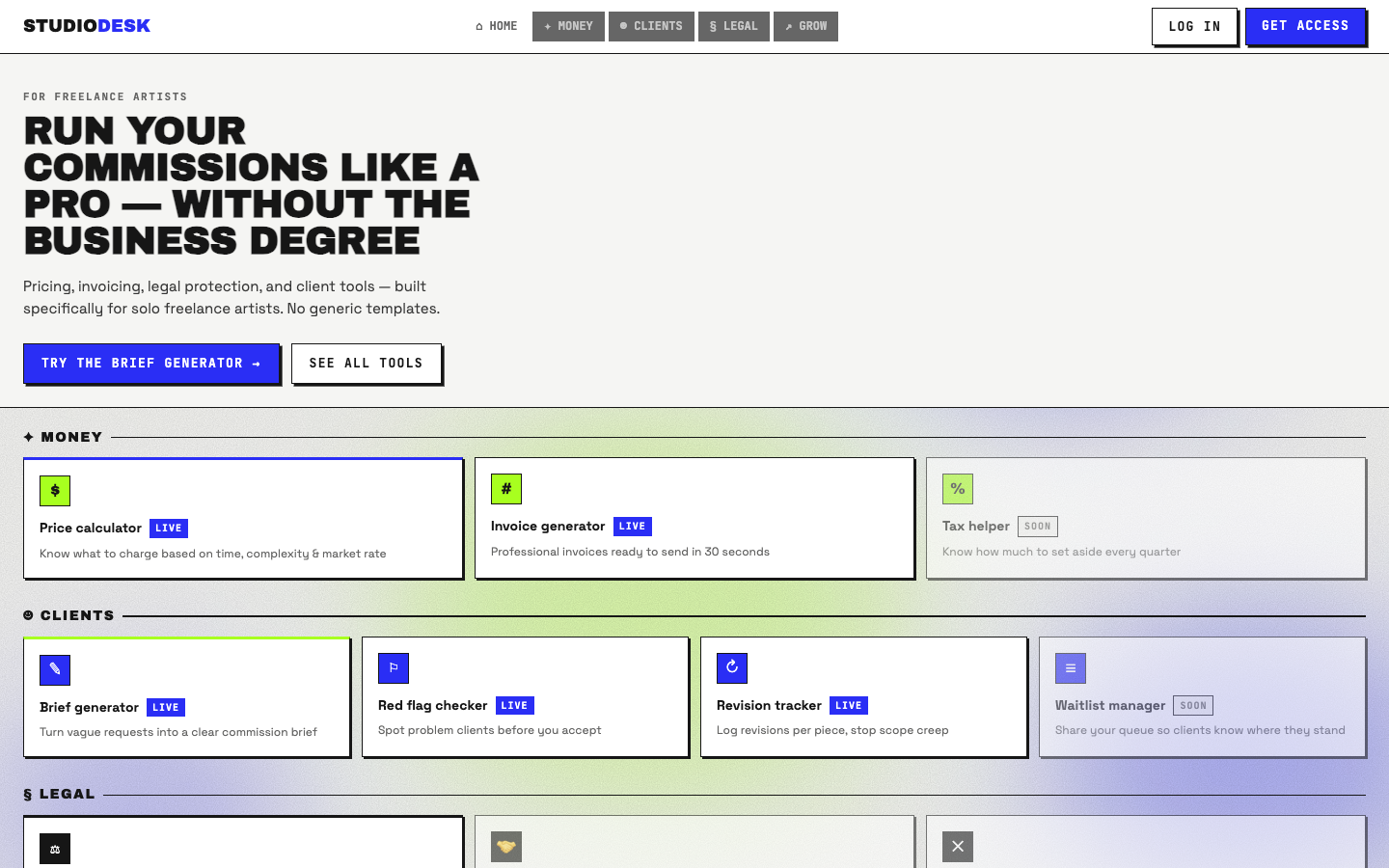
StudioDesk is a suite of 8 browser-based business tools built specifically for freelance commission artists. The full suite covers pricing, invoicing, client management, legal protection, and growth templates — organized into four categories: Money, Clients, Legal, and Grow. I designed and built the entire product solo: brand identity, UI/UX, and frontend. No backend servers, no accounts required for free tools. One-time bundle pricing ($9 / $19 / $35) instead of subscriptions.
Commission artists are running real businesses with no real business tools. The typical setup is: pricing by gut feeling, invoicing through Google Docs, no terms of service, and dreading every rate-increase or scope-creep conversation. When they do try to use existing tools — Wave, FreshBooks, generic contract templates — those tools speak the language of agencies and consultants, not "OC commission," "revision round," or "commissions open." The vocabulary mismatch alone is enough to make artists skip the tool entirely. The consequence is predictable: artists undercharge because they have no structured way to think about time and complexity. They get burned by problem clients because there's no documented agreement. They avoid raising rates because they don't know how to announce it. And when something goes wrong mid-project, they have no paper trail. The goal for StudioDesk was simple: build the tools that should have existed already, in the language artists actually use, with zero learning curve.
8 tools across 4 categories: Money • Price Calculator — estimates a fair commission price based on hourly rate, complexity, character count, and turnaround time. Free to use. • Invoice Generator — builds a professional invoice ready to send in under a minute. Free to use. • Tax Helper (coming soon) — quarterly set-aside calculator so artists know exactly what to save for taxes. Clients • Brief Generator — turns a vague commission request into a structured brief with pose, style, references, deadline, and extras. Free to use. • Red Flag Checker — a checklist that surfaces warning signs in a new client or project before the artist commits. Free to use. • Revision Tracker — logs revisions per commission so scope creep is visible and documentable. Free to use. • Waitlist Manager (coming soon) — lets artists show clients their queue position when commissions are open. Legal • ToS Generator — writes a custom terms of service in plain English based on the artist's specific working style. Free to try. • Collab Contract (coming soon) — revenue split and credit terms for artist collaborations. Grow • Commissions Open — generates a platform-ready announcement post for when commissions open, pre-filled with the artist's rates and slots. • Rate Raise Post — drafts a confident rate-increase announcement so artists don't have to stare at a blank caption box dreading the post.
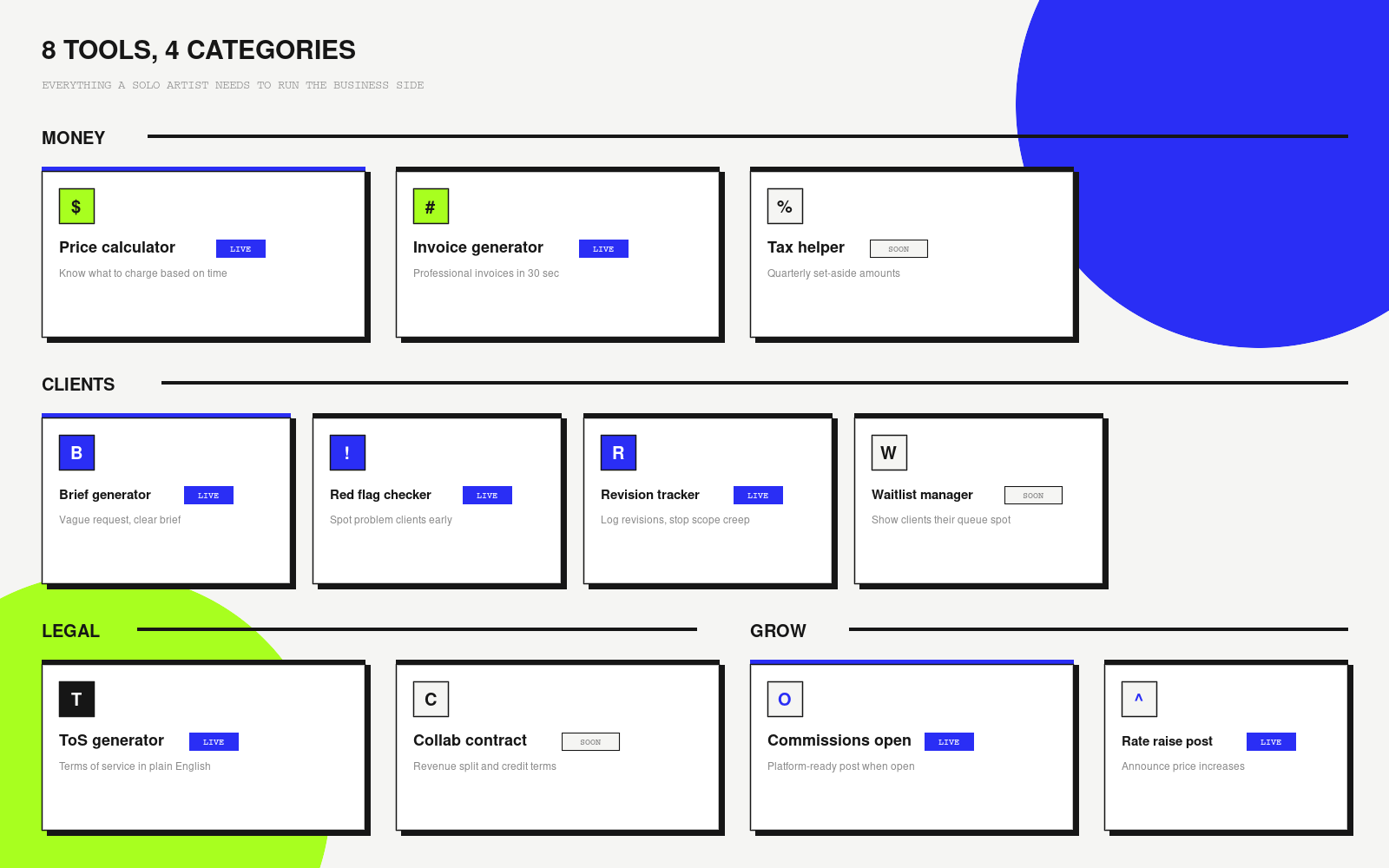
The brief to myself: it should feel like a tool made by an artist, not adapted from a SaaS template. That ruled out anything clean and corporate. The visual direction ended up as a deliberately loud neo-brutalist system — hard drop shadows, a paper-and-ink base palette (off-white #f5f5f3, flat black #161616) punched up with electric blue (#2a2ef5) and lime green (#a8ff1f), Archivo Black for display type, DM Mono for labels and metadata. The hard shadow card style was a deliberate choice — it's visually loud enough to feel designed, but the underlying information architecture is simple grids. Each tool page follows the same layout: a header with the tool name and one-line description, the tool inputs, the output, and a sidebar linking to related tools. No onboarding flows, no dashboards, no accounts. Color is used to communicate status: blue for live, neutral grey for coming-soon. That distinction runs through the homepage grid, the sidebar badges, and the card components consistently.
Every tool is a self-contained HTML/CSS/JS file. No frameworks, no build step for deployment, no server. The decision to go fully static was intentional — it eliminates hosting complexity, keeps load times near-instant, and means data never leaves the user's browser. For artists who are wary of cloud tools touching their client data, that's a real feature, not just a technical implementation detail. The shared design system lives in a single styles.css that all tools import: color tokens, the grain texture overlay, card shadows, button variants, badge styles, and the navigation sidebar. Adding a new tool means copying a template, swapping the content, and it inherits the full visual language automatically. The one trade-off with this approach is that there's no cross-tool data sharing — the Price Calculator can't pre-fill the Invoice Generator, for example. For the first version that's an acceptable limitation; artists are used to copying a number across.
Three one-time bundles, no subscription: • $9 — Starter Kit (Wave 1, 4 tools): Price Calculator, Invoice Generator, ToS Generator, Brief Generator • $19 — Business Kit (Waves 1 + 2, 8 tools): everything in Starter plus Red Flag Checker, Revision Tracker, Rate Raise Post, Commissions Open • $35 — Pro Bundle: all current and future tools, lifetime updates The free tools (Price Calculator, Brief Generator, Red Flag Checker, Revision Tracker) act as the on-ramp. Artists can get real value before paying anything, which means the paid bundle is a logical upgrade rather than a cold ask.
The launch strategy is fully organic with zero ad spend. The target communities are already organized around the problem — r/artbusiness, r/HungryArtists, Twitter/X (#commissionsopen, #artistsontwitter), Instagram (commission artists, art business creators). The framing that fits those spaces: "I built this because I needed it" rather than "here's my product launch." The hook tool is the free Price Calculator — low friction, immediate value, no sign-up. The first week of launch is the Price Calculator only, with follow-up spotlights on individual tools across the two-week campaign. Reddit presence is built up through genuine participation before any direct promotion post. The go-to-market plan targets 500 unique visitors and 25 paid bundle purchases in the first two weeks. The longer-term runway is expanding the "soon" tools (Tax Helper, Waitlist Manager, Collab Contract) based on real artist feedback rather than building in a vacuum.
StudioDesk launched as a fully functional 8-tool suite with zero backend infrastructure. The brand and all tooling was designed and built solo over roughly four months. The product is live at studiodesk.